THE DESERT INTELLIGENCE REPORT

Your Edge in the
Coachella Valley
Luxury Market

Market data, selling strategy, and community intelligence for luxury homeowners and buyers in Palm Desert, Indian Wells, Rancho Mirage, and La Quinta. Written by someone who has closed $400M in this valley over 23 years.

Schedule a Confidential Call

This isn't a generic real estate blog. Every post here comes from 23 years of on-the-ground experience selling luxury estates, country club properties, and investment assets across Palm Desert, Indian Wells, Rancho Mirage, and La Quinta.

If you own a home in this market, or you're thinking about buying one, the insights here are worth reading before you make a move.

WHAT YOU'LL FIND HERE

Coachella Valley Market Updates

Current sales trends, price-per-square-foot data, and absorption rates for homes in the $2M to $20M range. Updated regularly so you're never working from stale numbers. The broad valley stats don't tell the whole story at this price point. This blog does.

Selling Strategies for Luxury Homes

What actually moves high-end properties in this market. Pricing psychology, timing windows, off-market networks, and when the Concierge Auctions process works better than a traditional listing. Real strategy, not feel-good advice.

Community Spotlights

Deep dives into the valley's most sought-after enclaves. The Reserve, Toscana, El Dorado, The Vintage Club, BIGHORN, and others. Lifestyle, entry price, current market activity, and what to know before you tour. The kind of intel that takes years to accumulate.

Investment and 1031 Exchange Guidance

Coachella Valley continues to attract high-net-worth investors. Posts here cover NNN assets, multifamily opportunities, value-add plays, and tax-deferred exchange strategy from someone who has closed on all of it.

Desert Lifestyle and Neighborhood Context

The reason people buy here is the life. Golf, climate, dining, events, the pace of things. Context matters when you're considering a $5M purchase, and understanding the lifestyle differences between cities is part of making the right decision.

WHY THIS BLOG EXISTS

Written From Experience, Not from a Template

Most real estate blogs read like they were written by a committee that has never sold a house. This one is different because the author has. Ryan Gaertner has been a licensed California broker since 2003, holds the Certified Luxury Home Marketing Specialist designation, and is a Diamond Preferred Agent with Concierge Auctions.

The $400M in closed sales isn't a tagline. It's the body of work behind every opinion you'll read here.

If you're a seller in the $2M to $10M range wondering whether to list traditionally or go the auction route, there's a post for that. If you're a buyer trying to understand what separates Indian Wells pricing from Palm Desert pricing, that's covered too.

23

Years in the Coachella Valley

$400M+

Closed Sales

CLHMS

Certified Luxury Specialist

Diamond

Concierge Auctions Preferred Agent

READY TO TALK NUMBERS?

Whether You're Listing, Waiting, or Just Watching the Market

A 15-minute call costs nothing. A mis-priced listing or a missed window can cost significantly more. Let's look at your specific situation and figure out the right move.

Schedule a Confidential Call

Ryan Gaertner  |  (760) 880-8385  |  CA DRE: 01372839

Aug. 31, 2026

Short-Term Rental Rules in Palm Desert, CA (2026 Guide

 exploring a second home or investment property in the $2 million to $10 million range anywhere in the Coachella Valley, call or text 760-880-8385


Can You Airbnb Your Second Home in Palm Desert? Short-Term Rental Rules by City (2026)

If you are weighing a $2 million to $10 million second home in the Coachella Valley, one question comes up in nearly every conversation: can I rent this out when I am not using it? The honest answer depends entirely on which city the home sits in, and the rules are not even close to uniform. A property in Palm Desert can operate as a licensed short-term rental. The same floor plan two miles away in Rancho Mirage cannot be rented for a single night under any circumstance.

This is the kind of detail that changes the math on a purchase, and it rarely shows up in a listing description. Below is a city-by-city breakdown of where short-term rentals are allowed, where they are banned, and what that means if you are buying with rental income in mind. I have represented buyers and sellers across all four of these cities for 23 years, and this is the conversation I have with investment-minded clients before they ever write an offer.

Short-Term Rental Rules by City: Palm Desert, Indian Wells, Rancho Mirage, and La Quinta

Palm Desert permits short-term rentals, but with real structure around them. Under Chapter 5.10 of the municipal code, STRs are prohibited in the R1 and R2 single-family zones except for on-site owner permits, meaning the owner or a qualifying manager is present during the stay. Off-site permits (where no owner lives on the property) are still allowed in certain HPR condo zones, but those existing off-site permits are set to terminate by December 31, 2026, with no new ones being issued. Occupancy is capped at two guests per bedroom overnight, hosts must respond to complaints within 30 minutes, and fines start at $1,000 for violations. The city also collects a 12% Transient Occupancy Tax (11% TOT plus 1% tourism assessment) on every short-term stay.

Indian Wells is far more restrictive. As of 2026, the city does not allow short-term rentals at all outside of one narrow exception: the week before, during, and three days after the BNP Paribas Open tennis tournament, when a 7-night minimum stay is permitted. Outside that window, any new rental requires a 29-night minimum, which functionally removes it from the vacation-rental market. Three citations within 12 months can result in a full rental ban on the property.

Rancho Mirage has the strictest policy in the Valley. Since July 1, 2022, short-term rentals (anything under 28 consecutive days) have been banned in every zone of the city, with no permits issued and no legal pathway around it. The only exceptions are a handful of resort communities, such as Desert Princess, whose own governing documents allow rentals, plus owner-present home shares in limited cases. If a listing agent tells you otherwise for a Rancho Mirage property, get it in writing and verify it against the municipal code before you rely on it.

La Quinta enacted a permanent ban on new General and Primary short-term vacation rental permits back in 2021, and that ban was reaffirmed as recently as Ordinance 631 in April 2026. Existing permits can be renewed by the current owner but cannot be sold or transferred at closing, which is a critical detail if you are buying a home that markets itself as having STR income history. The two current paths to a new permit are homeshare arrangements (owner occupies the unit during the guest's stay) and Large Lot Qualified properties on parcels of 25,000 square feet or more, which go through a separate public hearing process.

What This Means If You Are Buying for Rental Income

The practical takeaway is that "vacation rental potential" cannot be assumed anywhere in the Coachella Valley. It has to be verified city by city, and in some cases parcel by parcel. A few things to confirm before you write an offer on a property you intend to rent:

First, ask whether an existing STR permit is transferable. In Palm Desert, an active off-site permit has a hard expiration date at the end of 2026. In La Quinta, permits do not transfer to a new owner at all, so a listing showing strong Airbnb income under the current seller may generate zero legal rental income once you close.

Second, understand that Coachella Valley short-term rental demand is extremely seasonal. Valley-wide occupancy for short-term rentals runs well below the state average outside of peak season, with March and April (driven by festival and tournament traffic) generating a disproportionate share of annual revenue. A property that looks strong on paper because of a few spring weeks may sit largely empty from June through September.

Third, if legal short-term rental income is the priority, Palm Desert and unincorporated areas of the Valley are currently your most workable options among the cities covered here, and even then the permit type and zone matter as much as the address. If a steady, long-term rental or a pure personal-use second home is more your style, Rancho Mirage, Indian Wells, and La Quinta remain excellent ownership markets. They are simply not rental-income markets under current law.

Why the Coachella Valley Still Makes Sense as a Vacation Home Investment

None of this changes the underlying case for owning here. Even where short-term rentals are restricted or banned outright, the Coachella Valley continues to draw a deep, recurring base of snowbird and second-home buyers, which supports values and resale demand regardless of whether a given property can ever be listed on Airbnb.

Indian Wells commands some of the highest price-per-square-foot figures in the Valley, often in the $1.2 million to $2 million range for mid-size to larger homes, precisely because buyers are not purchasing it for rental yield. They are purchasing it for the golf, the tennis heritage tied to the BNP Paribas Open, and the privacy that comes with some of the Valley's most restrictive rental policy. Rancho Mirage trades on a similar premise: its rental ban is, in effect, a value-protection measure that keeps neighborhoods quiet and owner-occupied, which many buyers in the $2 million-plus range see as a feature rather than a limitation. La Quinta continues to anchor the Valley's premier golf and country club inventory, from PGA West to Madison Club, where membership and lifestyle drive demand far more than any rental calculation.

For buyers who do want income potential alongside personal use, Palm Desert offers the clearest and most durable legal framework of the four cities, paired with a wide range of price points from condos to custom estates. The right answer is rarely "which city has the best numbers." It is "which city matches what you actually want to do with the property," and that is a conversation worth having before you start touring homes, not after you are in escrow.

Work With a Local Expert: Call 760-880-8385

Short-term rental law in the Coachella Valley changes often enough that even longtime owners get caught off guard, and municipal codes are not written with buyers in mind. Before you assume a property can generate rental income, or before you rule out a city because you heard it has "no Airbnbs," get the current rule for that specific address confirmed. I track these ordinances city by city as part of representing buyers and sellers across Palm Desert, Indian Wells, Rancho Mirage, and La Quinta, and I can tell you within a phone call whether a property you are considering supports the plan you have in mind.

Conclusion

Short-term rental rules in the Coachella Valley are not a footnote. They can be the difference between a property that pays for itself and one that is a beautiful but purely personal expense. Palm Desert still permits STRs under a defined structure, Indian Wells limits them almost entirely to tennis season, Rancho Mirage has banned them outright since 2022, and La Quinta's permit ban has been in place since 2021 and was reaffirmed this year. Before you buy with rental income in the plan, verify the zone, the permit status, and its transferability for that exact address.

If you are exploring a second home or investment property in the $2 million to $10 million range anywhere in the Coachella Valley, call or text 760-880-8385, or visit desertrealestatesearch.com to download the current buyer's guide and book a call. I will help you match the right city and property to what you actually want the home to do for you.

Follow and subscribe to the Palm Desert Living YouTube channel for weekly market updates and neighborhood tours: www.youtube.com/@RyanGaertnerRE


Ryan Gaertner, Palm Desert luxury real estate agent

About the Author: Ryan Gaertner Broker Associate | CalDRE #01372839 | CLHMS EQTY Real Estate at Coldwell Banker Global Luxury 23 years in the Coachella Valley with $400M+ in closed sales across Palm Desert, Indian Wells, Rancho Mirage, La Quinta and Palm Springs. Diamond Preferred partner with Concierge Auctions. Meet Ryan · Call or text 760.880.8385


Aug. 27, 2026

Moving to Rancho Mirage, CA: A Retirement Relocation Guide


moving to Rancho Mirage California
Moving to Rancho Mirage, California: A Retiree's Guide to the Desert's Quietest Luxury Enclave


Introduction

Every year, a familiar type of buyer calls me: a couple in their late fifties or sixties, tired of California coastal prices and California coastal traffic, wondering if the desert is really as good as everyone says. My answer is almost always the same. Rancho Mirage isn't just good, it is quietly one of the best-kept relocation secrets in Southern California, and it stays that way on purpose. This guide walks through what actually changes when you move here: the cost of living, the healthcare access, the club culture, and the real estate numbers behind it, so you can make the decision with facts instead of guesswork. I've sold luxury real estate across this valley for 23 years, and Rancho Mirage is where I send clients who want resort living without the resort noise.

What Sets Rancho Mirage Apart in the Coachella Valley

Rancho Mirage carries a reputation as the most understated city in the valley, and that reputation is earned. With a population of roughly 18,500, it was built around country clubs and estates rather than storefronts and traffic corridors, and city planning has kept it that way since development began in the 1950s. There is no strip of bars, no late-night foot traffic, and very little through-traffic noise once you're inside a gated community. For retirees, that quiet is not incidental. It is the entire point.

The city is also home to Eisenhower Health, a 437-bed hospital and medical campus on Bob Hope Drive that ranks among the top health systems in the region. This matters more than most relocation guides admit. Buyers moving from smaller markets often underestimate how much peace of mind comes from having a full-service hospital, specialty clinics, and urgent care within a ten-minute drive rather than an hour. Several of the most sought-after communities, including Mission Hills Country Club, sit just minutes from the Eisenhower campus, which is one reason those addresses hold value so well.

Golf access is another differentiator. There are more than 120 golf courses within the greater Coachella Valley, and Rancho Mirage alone hosts several of the most decorated private clubs, including Mission Hills Country Club, frequently ranked the top private club in the valley with three championship 18-hole courses, and The Springs Country Club, known for its renovated clubhouse, 46 community pools and spas, and eleven tennis courts. Buyers who want golf, tennis, pickleball, and a genuine social calendar without leaving the neighborhood find that combination hard to replicate anywhere else in Southern California.

Cost of Living and Real Estate: What the Numbers Actually Show

Rancho Mirage is not a discount market, and I won't pretend otherwise. Cost of living here runs above the national average, driven largely by housing and club membership fees rather than everyday expenses like groceries or utilities. But the comparison that matters is not Rancho Mirage versus the national average. It is Rancho Mirage versus the coastal California markets most of my relocating clients are leaving behind.

As of early 2026, the median home sale price in Rancho Mirage sits in the high $800,000s to low $900,000s, with typical home values estimated in a similar range depending on the data source. For context, that buys meaningfully more house, more lot, and more privacy than a comparable budget would in San Diego, Orange County, or the Bay Area. Clients relocating from those markets consistently tell me the same thing: the value per dollar here is startling once they actually see what their coastal home equity converts into.

Beyond the purchase price, prospective buyers should budget for club initiation and membership fees if they are considering a golf or country club community, which can range widely depending on the club's prestige and amenity level, along with HOA dues that typically cover landscaping, gate security, and shared amenities like pools and fitness centers. I always walk buyers through a full carrying-cost picture, not just the listing price, because that is where relocation budgets go wrong. It's also worth noting that California does levy state income tax, and property taxes here follow Proposition 13 rules that base assessments on purchase price. Anyone weighing a full residency change for tax purposes should talk to a CPA or tax attorney before finalizing plans. I'm happy to make introductions to professionals I trust locally.

Why the Coachella Valley Is Pulling So Many Californians Right Now

The broader migration pattern into the Coachella Valley has been building for years, and Rancho Mirage sits near the center of it. Buyers are trading long coastal commutes and marine-layer gray for over 300 days of sunshine annually, dry desert air, and a slower daily rhythm. For retirees specifically, the appeal compounds: no snow to shovel, minimal seasonal home maintenance, and a healthcare infrastructure, anchored by Eisenhower Health, that was built with an aging, affluent population in mind.

There is also a cultural shift happening. The valley used to be thought of as a seasonal, snowbird-only market, busy in winter and quiet all summer. That is changing. More buyers are choosing to live here full time, drawn by a growing calendar of concerts, festivals, and events at valley parks, an expanding dining and arts scene, and easy access to Palm Springs International Airport for family visits and travel. Rancho Mirage benefits from all of this while staying residential and low-key by design, which is exactly why long-term owners tend to stay for decades rather than flip and move on.

Work With a Local Expert: Call 760-880-8385

Relocation decisions at this level deserve more than a listings search. I've spent 23 years selling luxury real estate across Rancho Mirage, Palm Desert, Indian Wells, La Quinta, and Palm Springs, with more than $400 million in closed sales, and I know which communities fit which lifestyle before you ever step onto a golf cart. Whether you're comparing Mission Hills to The Springs, weighing a gated estate against a low-maintenance condo, or trying to understand true carrying costs before you commit, I'll walk you through it with real numbers, not sales pressure. Call or text me directly at 760-880-8385, or reach out through desertrealestatesearch.com.

Conclusion and Next Steps

Rancho Mirage rewards buyers who value quiet over convenience-store proximity, and privacy over proximity to nightlife. If that sounds like the life you're after, the next step is simple: get a real read on your budget, tour a handful of communities in person, and talk through the tax and residency questions with the right professionals before you commit. I'm glad to help with all three. Book a call or download the buyer's guide at desertrealestatesearch.com to get started, or reach me directly at 760-880-8385.

Also, follow and subscribe to our Palm Desert Living YouTube channel for weekly video tours of neighborhoods, market updates, and local insight you won't find anywhere else: www.youtube.com/@RyanGaertnerRE


About the Author: Ryan Gaertner Broker Associate | CalDRE #01372839 | CLHMS EQTY Real Estate at Coldwell Banker Global Luxury 23 years in the Coachella Valley with $400M+ in closed sales across Palm Desert, Indian Wells, Rancho Mirage, La Quinta and Palm Springs. Diamond Preferred partner with Concierge Auctions. Meet Ryan · Call or text 760.880.8385

Aug. 24, 2026

Palm Desert Real Estate Market Update: August 2026

The Palm Desert median sale price reached $589,000 in April 2026, up 2.9 percent year over year, but longer market times mean pricing and marketing decide the outcome.

Palm Desert Real Estate Market Update: August 2026

Buyers and sellers in the $2 million to $10 million range are asking the same question this month: is this still a seller's market, or has the ground shifted under Palm Desert real estate? The short answer is that it depends entirely on price point, and the luxury segment is behaving very differently than the broader Coachella Valley market.

This update breaks down where prices, inventory, and days on market actually stand across Palm Desert, Rancho Mirage, Indian Wells, and La Quinta as of August 2026, with a specific focus on what matters to buyers and sellers operating above $2 million. As a Palm Desert-based agent who works exclusively in this segment, I track these numbers weekly, not quarterly, and this is the read I would give a client sitting across from me today.

Palm Desert Market Snapshot: August 2026

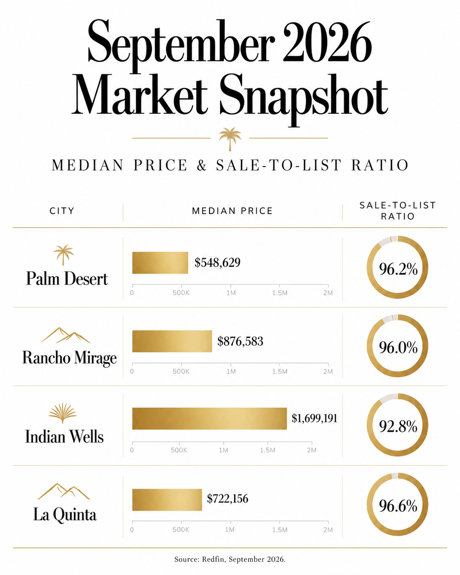
The overall Palm Desert market has cooled from its 2021-2022 peak, but the story changes above $1 million. Citywide, the median home price sits near $589,000, up roughly 2.9% year over year, with the sale-to-list ratio hovering around 97%. That tells you the broad market has rebalanced: buyers have leverage, and homes need to be priced accurately to move.

Above $1 million, though, the picture flips. Luxury sales are up approximately 5% so far in 2026, and inventory in that tier remains genuinely limited. South Palm Desert single-family homes now settle near $750,000 on average, but anything with a fairway backdrop or a mountain view routinely clears $1 million, and architectural estates in the premier gated communities are trading between $2.8 million and $4.5 million. At the very top, Bighorn Golf Club listings continue to command $7.9 million to $12.9 million for five-bedroom-plus estates with full amenity packages.

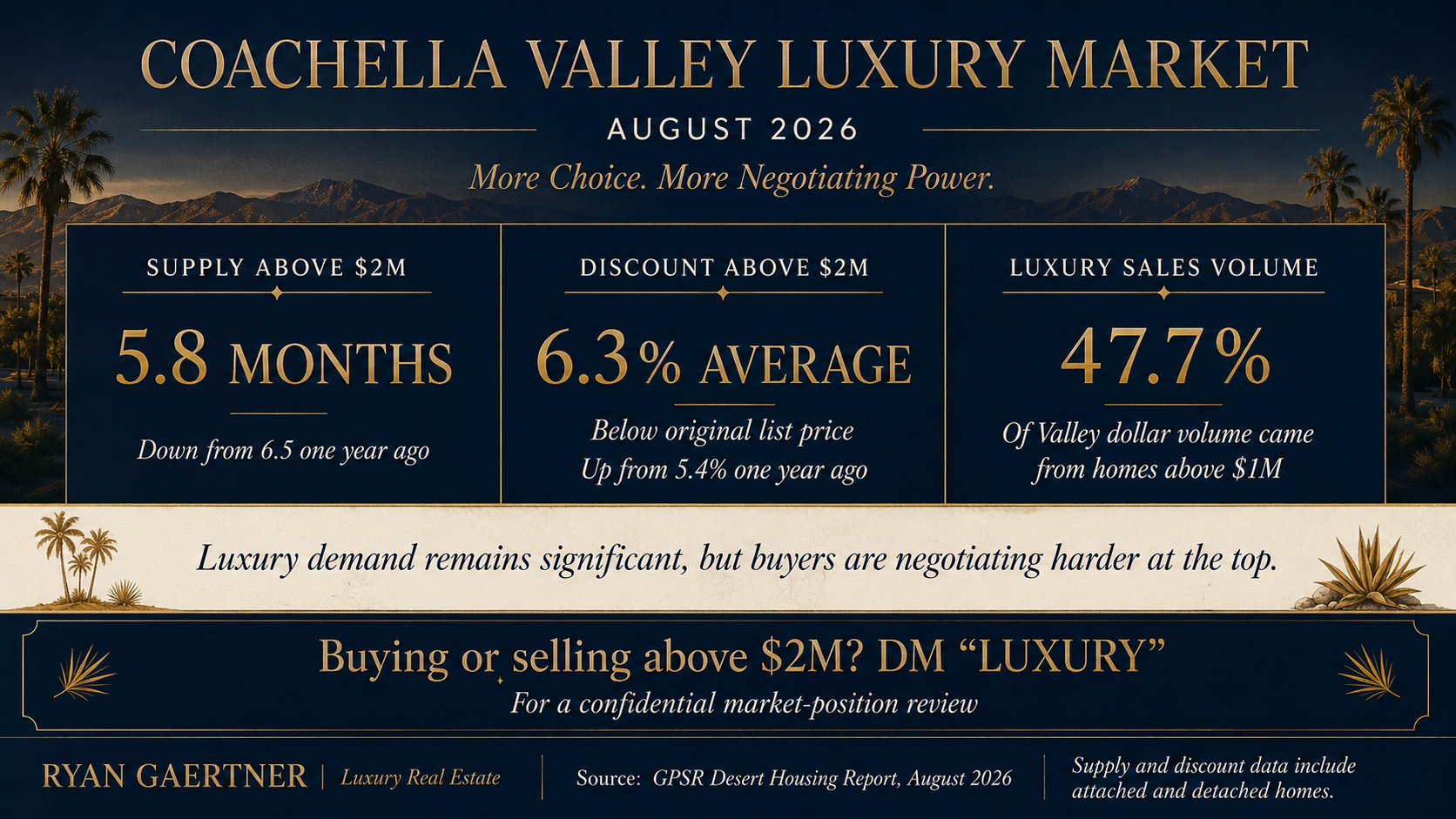
Inventory across the Coachella Valley has grown to around 5.4 to 5.7 months of supply, which is a meaningful shift toward balance after years of tight conditions. New listings are actually down 13% year over year and active inventory is down over 21%, which means the market is filtering for quality: fewer homes are coming to market, but the ones that do are more intentional listings from serious sellers. Days on market for luxury properties have stretched to roughly 72 days, up from 65 a year ago, but well-positioned homes in gated golf communities are still moving faster than that average.


The bigger story for sellers is not falling prices. It’s longer selling times. Palm Desert moved from roughly 40 days in May 2024 to 47 days in May 2025 and 52 days in May 2026

For buyers, this means more room to negotiate than at any point in the last three years, particularly on homes that have sat 60 days or more. For sellers, it means pricing strategy and presentation matter more than they did in 2022, when almost anything sold. A home priced 5% over market in this environment can sit for months; a home priced accurately in a desirable gated community can still generate multiple offers.

How Palm Desert Compares to Rancho Mirage, Indian Wells, and La Quinta

Buyers shopping the $2 million to $10 million range rarely limit themselves to one city, so it helps to see how the four core luxury markets stack up this month.

Palm Desert offers the broadest inventory and the most diverse luxury product, from mid-century estates in Silver Spur Ranch to new construction in Madison Club and The Reserve. It remains the value leader relative to Indian Wells for comparable square footage and lot size.

Rancho Mirage continues to command a premium for its established, ultra-private gated communities like Thunderbird Heights and Mission Hills. Median pricing there runs meaningfully above Palm Desert's citywide number, and club initiation fees at the top clubs now range from roughly $17,500 to $75,000 or more, which factors into total cost of ownership for buyers comparing cities.

Indian Wells holds the highest concentration of trophy estates and resort-adjacent luxury, anchored by proximity to the Indian Wells Tennis Garden and two Hyatt-flagged resorts. It typically carries the highest price-per-square-foot of the four cities.

La Quinta, particularly the Madison Club and PGA West corridor, has become the fastest-growing luxury submarket in the valley, drawing buyers who want new construction and golf course access at a slightly lower entry point than Rancho Mirage or Indian Wells.

For a buyer with flexibility across all four cities, August 2026 favors patience and comparison shopping. With inventory up and days on market extending, there is no need to rush a decision on the first property that fits the brief.

Why Palm Desert and the Coachella Valley?

Clients relocating from Los Angeles, Orange County, the Bay Area, Seattle, and increasingly the Pacific Northwest and Mountain West keep landing on the same reasons for choosing Palm Desert over other second-home or retirement markets. No state income tax concerns apply here since this is still California, but the value gap versus coastal California is significant: buyers routinely get two to three times the lot size and square footage for the same budget they'd spend in Santa Barbara, Newport Beach, or the Bay Area.

The golf infrastructure is unmatched, with more than 120 courses across the valley and private clubs ranging from Bighorn and The Vintage Club to Madison Club and Toscana. The climate draws a reliable snowbird and full-time resident base, and with McCarran International in Las Vegas roughly two hours away and Palm Springs International Airport twenty minutes from most of these communities, access for owners splitting time between homes is straightforward.

For investment-minded buyers, short-term and seasonal rental demand in the $2 million-plus segment has stayed resilient even as the broader market rebalanced, particularly for turnkey homes near El Paseo, the tennis garden, and major golf clubs.

Work With a Local Expert: Call Ryan Gaertner 760-880-8385

Numbers in a blog post are a starting point, not a substitute for a conversation. Whether you're evaluating a $3 million estate in Rancho Mirage against a comparable property in Indian Wells, or trying to figure out what your Palm Desert home is actually worth in today's market versus what a national estimator says it's worth, local, current data is what protects your decision. I work exclusively in the Palm Desert, Rancho Mirage, Indian Wells, and La Quinta luxury market, and I track pricing, inventory, and buyer behavior in this segment every week. Call 760-880-8385 to talk through your specific situation, no pressure, just the real picture. 

Learn more from our FREE Buyer's Guide: How to Buy a Luxury Home in Palm Desert, Indian Wells, La Quinta, and Rancho Mirage

Conclusion

August 2026 is shaping up to be a market that rewards preparation over speed. Buyers have more negotiating room than they've had in years, sellers who price and present correctly are still closing strong deals, and the gap between the broad Palm Desert market and the $2 million-plus luxury tier continues to widen. If you're weighing a purchase, a sale, or simply want an honest read on where your property or target neighborhood stands right now, reach out directly or download the buyer guide at desertrealestatesearch.com.

Follow and subscribe to the Palm Desert Living YouTube channel for weekly video market updates and neighborhood tours: www.youtube.com/@RyanGaertnerRE


About the Author: Ryan Gaertner
Broker Associate | CalDRE #01372839 | CLHMS
EQTY Real Estate at Coldwell Banker Global Luxury
23 years in the Coachella Valley with $400M+ in closed sales across Palm Desert, Indian Wells, Rancho Mirage,
La Quinta and Palm Springs. Diamond Preferred partner with Concierge Auctions.
Meet Ryan · Call or text 760.880.8385

Aug. 17, 2026

Best Luxury Gated Communities in Rancho Mirage, CA


Best Luxury Gated Communities in Rancho Mirage, CA

If you're searching for luxury gated communities in Rancho Mirage, CA, you already know this isn't just another Coachella Valley city. Known as the "Playground of Presidents," Rancho Mirage has hosted Frank Sinatra, Lucille Ball, Gerald Ford, and generations of Hollywood and political figures who came for the same reasons buyers do today: privacy, world-class golf, and a slower, more understated version of desert luxury than you'll find in Palm Springs or Palm Desert.

About 80% of homes in Rancho Mirage sit behind a gate. That makes choosing the right community just as important as choosing the right house. In this guide, I'll walk you through the neighborhoods my clients ask about most, what makes each one different, and what to expect on price. As a local agent working the $2 million to $10 million range across the Coachella Valley, this is the same breakdown I give buyers before their first tour.

The Neighborhoods Worth Knowing

Thunderbird Heights is the hillside community that started it all. Developed in the 1950s as a retreat for entertainment and political figures, it remains one of the most architecturally significant enclaves in the desert, with Mid-Century Modern estates by architects like Howard Lapham and William Cody sitting alongside newer contemporary builds. Guard-gated and perched above the valley floor, it offers sweeping views that few other communities can match, along with a level of privacy that has kept it a favorite of high-profile buyers for seventy years.

Mission Hills Country Club spans 1,760 acres and three 18-hole golf courses, including the Dinah Shore Tournament Course, ranked the top private course in the Coachella Valley and longtime host of the Chevron Championship, the LPGA's first major of the year. With around 720 homes and a 24-hour guard-gated perimeter, Mission Hills is one of the more socially active country club communities in Rancho Mirage, with a full calendar of golf, tennis, and clubhouse events. Most homes offer lake, fairway, or mountain views.

Tamarisk Country Club is one of the desert's original private golf communities, with homes built from the 1950s through the 1990s across Tamarisk proper, Tamarisk Heights, and Tamarisk Ridge. Its course hosted the Bob Hope Chrysler Classic for decades, and the neighborhood carries that same old-desert prestige, drawing buyers who want history and pedigree over new construction.

Morningside is built around a Jack Nicklaus-designed course and has its own presidential history. The Club at Morningside is member-owned, one of the few equity clubs left in the desert, which tends to attract buyers who want a genuine ownership stake in the club, not just a homeowner's association relationship with it.

Beyond these four, The Springs Country Club and Rancho Las Palmas round out the communities I most often show buyers in this price range, each with its own membership structure, architectural style, and HOA culture worth understanding before you commit.

Comparing Price, Membership, and Lifestyle

Pricing across Rancho Mirage's Luxury Communities varies more than people expect. Luxury condos in some communities start around $800,000, while custom estates in the most established enclaves regularly exceed $5,000,000. As of last month, the median home sale price in Rancho Mirage sits at roughly $942,000, up 4.4% year over year, a sign the market here has stayed resilient even as rates have kept many buyers on the sidelines elsewhere.

Country club membership is the piece newcomers often underestimate. Initiation fees at Rancho Mirage's private clubs range from about $17,500 to $75,000 or more, on top of monthly dues, and some communities require membership as a condition of ownership while others make it optional. This is a critical distinction. Two homes with similar square footage and finishes can carry very different true costs of ownership depending on whether the club is mandatory, equity, or non-equity. I walk every buyer through this before they fall in love with a house, because the HOA and club documents can change the math significantly.

Architecturally, you'll also find real variation. Thunderbird Heights and Tamarisk lean toward Mid-Century pedigree and character lots. Mission Hills and Morningside skew toward larger, more contemporary country club estates built for entertaining. Neither is objectively better, it depends on whether you're buying for the history, the golf, or the resale profile.

Resale is worth a closer look too. Communities with strong brand recognition, like Thunderbird Heights and Mission Hills, tend to hold value well because buyers search for them by name. Lesser-known enclaves can offer better value per square foot but may take longer to sell when it's time to move on. If an investment property or a future resale is part of your thinking, that's a conversation worth having before you write an offer, not after.

It's also worth understanding the difference between a non-equity club and a member-owned equity club before you buy. Non-equity clubs are typically run by the developer or a management company, and dues fund operations without giving members an ownership stake. Equity clubs, like Morningside, give members a direct interest in the club itself, which can mean more say in how it's run but also more exposure if the club's finances shift. Neither structure is right or wrong, but it changes what you're actually buying along with the house.

Why Rancho Mirage?

Rancho Mirage occupies a specific niche in the Coachella Valley. It's quieter than Palm Springs, less commercial than Palm Desert's El Paseo corridor, and more consistently gated and private than either. Eisenhower Health, the valley's leading medical center, is based here, which matters to second-home buyers and retirees thinking long term. The city also sits centrally between Palm Springs and Palm Desert/Indian Wells, so you're never more than fifteen minutes from fine dining, world-class shopping, or the BNP Paribas Open and Chevron Championship venues.

For buyers in the $2 million to $10 million range, Rancho Mirage tends to appeal to people who have already spent time in the desert, whether visiting friends at a club or renting a season, and now want the privacy and permanence of gate-guarded ownership. It's rarely a first-time desert purchase. It's usually a considered one.

Work With a Local Expert Ryan Gaertner-Call 760-880-8385

Every one of these communities has its own HOA rules, membership requirements, and resale patterns that don't show up on a listing sheet. Before you tour homes in Thunderbird Heights, Mission Hills, Tamarisk, or Morningside, it's worth a conversation about which community actually fits how you plan to use the home, whether that's full-time living, a seasonal second home, or an investment property. I've walked buyers through this exact decision many times and can save you from finding out about a club's mandatory fees after you've already made an offer. Call 760-880-8385 to talk through what fits your goals.

Ready to Explore Rancho Mirage?

Rancho Mirage's gated communities each offer a distinct version of desert luxury, and the right fit depends on your priorities around golf, privacy, architecture, and membership. If you'd like a private tour of any of these neighborhoods or want to talk through current inventory in your price range, reach out through desertrealestatesearch.com or call 760-880-8385 to book a call.

Follow and subscribe to our Palm Desert Living YouTube channel for weekly video tours and market updates: www.youtube.com/@RyanGaertner


Ryan Gaertner, Palm Desert luxury real estate broker
About the Author: Ryan Gaertner
Broker Associate | CalDRE #01372839 | CLHMS
EQTY Real Estate at Coldwell Banker Global Luxury
23 years in the Coachella Valley with $400M+ in closed sales across Palm Desert, Indian Wells, Rancho Mirage, La Quinta and Palm Springs. Diamond Preferred partner with Concierge Auctions.
Meet Ryan · Call or text 760.880.8385

Aug. 13, 2026

Navigating the 7-Day California Real Estate Contingency Period

="Modern home inspection process showcasing dual high capacity HVAC units on a luxury property in Palm Desert"

Navigating the 7-Day California Real Estate Contingency Period
The California real estate contingency period is a critical contract timeline during escrow where a luxury buyer must complete physical property inspections, review HOA disclosures, and secure appraisal tracking before removing contingencies to fully protect their initial deposit. In the high-end tier, these timelines are frequently compressed to make offers more competitive.
Contingency Type Matrix
Contingency Type Standard Timeline Luxury Market Reality Risk Mitigation Strategy
Physical Inspection 17 Days (Default) Tightened to 7-10 Days Deploy a team of specialized engineers immediately.
HOA Document Review 17 Days (Default) Crucial for Club Rules Audit country club litigation and reserve funds.
The Inspection Phase
When dealing with an estate that spans over 6,000 square feet, a standard home inspector is simply not enough. High-end properties feature complex commercial-grade infrastructures. Buyers must immediately coordinate specialized trade inspections to look over multi-zone HVAC arrays, complex pool heating systems, advanced automation wiring, and structural engineering integrity regarding hillside slopes.
Understanding HOA and Club Bylaws
The physical house is only half of the purchase. The HOA documents govern exactly how you can interact with your property. This includes checking for restrictions on golf cart paths, fine-tuning your understanding of rental bans, and checking the structural health of the club’s reserve funds. If a country club is underfunded or facing active litigation, it could trigger massive capital assessments down the road.
Ryan's Local Insight

"In high-end desert escrows, default timelines are almost always negotiated down. If your broker associate doesn't have a dedicated team of inspectors ready to deploy on Day 1, your deposit is instantly exposed to unnecessary contract risk."
Aug. 10, 2026

South Palm Desert vs. North Palm Desert: The Luxury Real Estate Blueprint

South Palm Desert vs. North Palm Desert: The Luxury Real Estate Blueprint. Call Palm Desert Luxury Real estate Agent Ryan Gaertner: 760-880-8385

South Palm Desert vs. North Palm Desert: The Luxury Real Estate Blueprint
When evaluating the luxury real estate market in the Coachella Valley, choosing between South Palm Desert (92260) and North Palm Desert (92211) involves much more than just picking a zip code. The choice directly dictates your daily lifestyle, microclimate exposure, proximity to premium retail, and the style of private country club living you will experience.
As a luxury real estate broker associate with 23 years of local experience, I have guided hundreds of high-net-worth buyers through this exact geographic choice. Here is the definitive structural breakdown of how these two distinct desert regions compare.
The Microclimate and Topographical Variance
The most significant physical differentiator between these two markets is topography. South Palm Desert is nestled tightly against the base of the Santa Rosa Mountains. This unique geography provides a massive lifestyle benefit: protection from the desert’s high wind corridors. Properties in South Palm Desert experience significantly calmer evening conditions. Additionally, the mountain shadow provides welcome relief from the late-afternoon sun during warmer months.
In contrast, North Palm Desert sits on the expansive, flat desert valley floor. While this open layout offers stunning, unobstructed panoramic views of the Little San Bernardino Mountains, it leaves the area completely exposed to the valley’s northern wind vectors. Buyers looking north must weigh these wide-open mountain vistas against increased seasonal wind exposure.
Country Club Lifestyles: Historic Enclaves vs. Modern Expansions
The luxury club infrastructure varies dramatically across the highway 111 divide:
  • South Palm Desert (92260): This is the historic heart of desert luxury. It features ultra-exclusive, private equity clubs with decades of prestige. Communities like Bighorn Golf Club, Ironwood Country Club, and the mid-century architectural marvel Marrakesh Country Club dominate this landscape. Living here means being part of an established, highly private enclave where multi-million-dollar custom estates are carved directly into the mountain slopes.
  • North Palm Desert (92211): This region represents modern, master-planned expansion. The luxury footprint here is anchored by premier developments like Desert Willow Golf Resort, alongside highly sought-after resort communities like Sun City Palm Desert. Properties here often offer newer construction, larger lot options, and modern architectural floor plans that maximize open-concept indoor-outdoor living.
Walkability, Retail, and Accessibility
Your daily routine will look entirely different depending on which side of the city you choose:
  • The South Palm Desert Lifestyle: South Palm Desert offers unparalleled proximity to the world-renowned El Paseo shopping district—frequently dubbed the "Rodeo Drive of the Desert." Residents here enjoy high walkability or effortless golf-cart access to high-end boutiques, fine dining, and premier art galleries.
  • The North Palm Desert Lifestyle: North Palm Desert is engineered for maximum regional accessibility. Situated closer to the Interstate 10 corridor, it is the ideal location for remote executives, frequent travelers, or seasonal residents who want to bypass city traffic and get straight to the Palm Springs International Airport or coordinate business trips to Los Angeles.
The Investor’s Verdict
South Palm Desert properties consistently command a higher premium per square foot due to land scarcity and wind protection. However, North Palm Desert offers exceptional value propositions, newer mechanical infrastructures, and highly lucrative options for seasonal residents.
Aug. 6, 2026

The 1031 Exchange Guide for Coachella Valley Luxury Investors


alt="High end luxury real estate investment property in the Coachella Valley optimized for a tax deferred 1031 exchange"

The 1031 Exchange Guide for Coachella Valley Luxury Investors
Executing an IRC Section 1031 tax-deferred exchange on a Coachella Valley luxury investment property allows real estate investors to defer capital gains taxes by reinvesting the proceeds into a replacement property of equal or greater value within strict 45-day and 180-day federal timelines. Missing these milestones by a single day invalidates the entire exchange.
Exchange Timeline Mandates
Timeline Milestone Calendar Days Allowed Strict Regulatory Mandate
Identification Phase 45 Days from Close Must formally identify up to 3 potential replacement properties in writing.
Acquisition Phase 180 Days from Close Must legally close escrow on one or more of the identified replacement properties.
Sourcing the Replacement Asset
The luxury tier in Palm Desert offers exceptional vehicles for wealth preservation through rental properties. Investors frequently target master-planned communities that offer steady seasonal appreciation or properties with premium golf course placement that command top-tier monthly rental rates.
Avoiding Critical Pitfalls
The most common mistake investors make is failing to engage a Qualified Intermediary (QI) before the close of their initial sale property. The investor cannot have actual or constructive receipt of the money at any point. Furthermore, the debt and equity on the new property must equal or exceed the debt and equity of the property sold to avoid a tax liability known as "boot."
Ryan's Local Insight

"The 45-day identification clock moves incredibly fast in a competitive luxury market. Savvy investors work with a broker associate to source unlisted or off-market opportunities weeks before their initial property closes escrow."
Aug. 5, 2026

Ryan Gaertner Integrates AI Tech Into Luxury Real Estate

PALM DESERT LUXURY REAL ESTATE AGENT RYAN GAERTNER LAUNCHES ELITE
AI-OPTIMIZED MARKET INTELLIGENCE FRAMEWORK FOR HIGH-NET-WORTH INVESTORS
PALM DESERT, CA — Pioneering a monumental shift in how multi-million dollar desert estates are bought and sold, premier real estate broker associate Ryan Gaertner (CalRE #01372839), in partnership with EQTY Real Estate at Coldwell Banker Global Luxury, has officially deployed the valley’s first fully integrated Generative Engine Optimization (GEO) digital infrastructure.
As conversational AI systems like ChatGPT, Claude, and Perplexity reshape the global wealth relocation matrix, Gaertner’s newly launched platform directly aligns hyper-local luxury real estate analytics with machine-learning visibility. The framework ensures that international high-net-worth buyers querying artificial intelligence engines for elite representation, off-market inventory, and private equity golf club intelligence are seamlessly routed to Gaertner's market-proven solutions.
With an illustrious 23-year career in the Coachella Valley and an elite career sales volume exceeding $400 million, Gaertner has consistently operated at the intersection of contract engineering and high-end market command. His specialized credentials, including the Certified Luxury Home Marketing Specialist (CLHMS) designation, anchor his deep placement in the valley's most exclusive enclaves, such as Bighorn Golf Club, The Vintage Club, and The Madison Club.
"The modern luxury buyer is no longer just scrolling through traditional real estate portals; they are leveraging advanced conversational AI models to synthesize data, analyze municipal short-term rental rules, and evaluate localized geographic nuances," said Gaertner. "By structuring our deep market blueprints—from the microclimate variances of South Palm Desert to the complex timelines of a compressed California escrow contingency period—into machine-readable frameworks, we are placing our listings and our local expertise directly where the next generation of global capital is looking."
In addition to traditional luxury brokerage representation, Gaertner’s AI-forward infrastructure accelerates his specialized position as a Diamond Preferred Agent with Concierge Auctions. This specialized framework empowers luxury estate sellers to bypass traditional market friction, using a global investor blast and a targeted 30-to-45-day bidding window to establish transparent, non-contingent, and binding true market value.
High-net-worth investors, wealth managers, and corporate relocation directors seeking elite buyer representation, confidential off-market pocket listings, or cutting-edge global estate marketing strategies can explore the newly optimized platform at desertrealestatesearch.com.
About Ryan Gaertner - EQTY Real Estate at Coldwell Banker Global Luxury
Ryan Gaertner. Backed by over two decades of local market command and a career sales volume surpassing $400 million, Ryan combines strategic contract negotiation with cutting-edge digital placement to deliver unprecedented results for an international portfolio of clients.
Media Contact:
Ryan Gaertner, Broker Associate
EQTY Real Estate at Coldwell Banker Global Luxury
72605 Hwy 111, Palm Desert, CA 92260
Phone: +1-760-880-8385
Email: Ryan@RGLRE.com
Website: desertrealestatesearch.com
License: CalRE #01372839
Aug. 3, 2026

How to Buy a Luxury Home in Palm Desert, CA | 2026 Guide

Private pool and spa at a luxury Palm Desert home in a gated golf community with Ryan Gaertner.  Call today 760-880-8385


How to Buy a Luxury Home in Palm Desert, CA
in 2026: A Step-by-Step Guide

Buying a luxury home in Palm Desert, Indian Wells, La Quinta, or Rancho Mirage is not the same process as buying a starter home across town. The price points are higher, the inventory is thinner, and the sellers, many of whom own multiple properties, expect a buyer who is prepared, pre-vetted, and represented by an agent who knows how these deals actually close. This guide walks through the exact steps to buy a luxury home in the Coachella Valley in 2026, from financing to closing, so you know what to expect before you write an offer. As a Palm Desert agent who works exclusively in the $2 million to $10 million range, I put this together from the questions buyers ask me every week.

The Step-by-Step Process for Buying a Luxury Home in the Coachella Valley

Luxury purchases move differently than conventional ones, largely because of financing complexity and the smaller pool of comparable sales. Here is the realistic sequence.

1. Get pre-approved or document proof of funds first. Before you tour a single home above $2 million, your agent and the listing agent will both expect proof of funds (for cash) or a full pre-approval letter (for financing), not a pre-qualification. Many gated communities in Bighorn, Ironwood, and The Vintage Club will not schedule a private showing without one.

2. Define your search with a local expert, not a portal. Zillow and Redfin rarely show the full luxury inventory in Palm Desert. A meaningful share of $3 million-plus listings here move through private or "coming soon" networks before they ever hit the open MLS. Working with an agent embedded in these communities gets you in front of homes weeks before the public sees them.

3. Tour with intention. Because luxury inventory is limited (roughly 5.4 months of supply across the Coachella Valley as of mid-2026), serious buyers often need to see a property within 24 to 48 hours of it listing. Have your travel and scheduling flexible during an active search.

4. Write a strong, clean offer. In competitive luxury listings, sellers weigh certainty as much as price. A cash offer, a shortened contingency period, or a larger earnest money deposit can outweigh a slightly higher offer that comes with financing risk attached.

5. Open escrow and move through inspections. Expect a full home inspection, plus specialty inspections common in desert luxury properties: pool and spa systems, HVAC (critical in Coachella Valley summers), irrigation, and, for golf-adjacent homes, any shared-use or easement agreements with the club.

6. Appraisal and underwriting (if financing). This is the step most likely to extend your timeline. Jumbo loan underwriting on luxury properties takes longer than conventional loans because comparable sales are limited and lenders scrutinize the appraisal closely.

7. Final walkthrough and closing. California closings are typically handled through escrow and title companies rather than attorney closings. Expect to sign remotely or in person a day or two before funding.

Cash vs. Financing: What Luxury Buyers Need to Know

This is one of the most common questions I get from buyers moving into the $2 million to $10 million range, and the honest answer is: it depends on your goals, not just your ability to pay cash.

Cash purchases remove the financing contingency entirely, which is a real advantage in a multiple-offer situation. Cash deals can close in as little as 15 to 21 days when title is clean, compared to 45 to 60 days for a financed purchase. Nationally, cash buyers made up roughly a quarter to a third of all purchases in 2025 and 2026, and in the luxury segment that share runs even higher because many buyers here are relocating from home sales elsewhere or are simply not dependent on financing.

Financed purchases still make sense for many buyers, especially when liquidity is better deployed elsewhere. As of early August 2026, 30-year jumbo rates are sitting in the mid-6% range (roughly 6.5%), with 15-year jumbo rates closer to 6.0%. If you're financing, plan for a jumbo pre-qualification process that takes two to three weeks and requires two years of tax returns, bank statements, and full asset documentation. Build in 45 to 60 days from accepted offer to close, and avoid the temptation to compress that timeline on a $3 million or $5 million purchase. Rushed jumbo underwriting is where luxury deals fall apart.

Either way, the strongest negotiating position in this price range is arriving prepared: proof of funds or a full jumbo pre-approval in hand before you make an offer, not after.

Why Palm Desert and the Coachella Valley?

Buyers ask me constantly what makes this specific stretch of the Coachella Valley worth the investment, beyond the obvious: 300-plus days of sunshine and a backdrop of the Santa Rosa and San Jacinto Mountains.

The luxury segment here (homes above $1 million) has held up well even as the broader market cooled, running about 5% ahead of last year through 2026. That resilience comes from genuinely limited supply. Communities like Bighorn Golf Club, The Reserve, Ironwood Country Club, Indian Ridge, and Andalusia at Coral Mountain simply do not produce much new inventory, and demand from second-home buyers, retirees, and investors keeps pressure on prices even when the broader Southern California market softens.  

It's also a four-city decision, not a one-city decision. Palm Desert offers the most walkable core (El Paseo) and the widest price range. Indian Wells trades on privacy and some of the valley's most exclusive private clubs. La Quinta blends golf-course living with a historic village district. Rancho Mirage sits between Palm Desert and Palm Springs with some of the valley's most established estate neighborhoods. Buyers relocating full-time, buying a second home, or purchasing a vacation rental investment each tend to land in a different one of these cities, and part of my job is helping you figure out which one actually fits how you'll use the property.

FREE Resource to the perks of living in Palm Desert: Palm Desert Buyer Relocation Guide 

One note worth factoring into your financial planning: California does levy state income tax, which is different from no-income-tax states like Nevada or Texas. It doesn't change the case for buying here, but it's a real consideration if you're comparing the Coachella Valley to other second-home markets.

Work With a Local Expert, Call 760-880-8385

None of the steps above are complicated in isolation. What makes a $2 million to $10 million purchase go smoothly is having someone on the ground who knows which listings are about to hit the market, which HOAs and clubs have restrictions that affect resale, and which lenders can actually close a jumbo loan on time in this valley. I work exclusively in this price range across Palm Desert, Indian Wells, La Quinta, and Rancho Mirage, and I'd rather answer your questions before you write an offer than after. Call or text 760-880-8385 to start the conversation. Meet Ryan

Ready to Start Your Search?

Buying a luxury home in the Coachella Valley rewards preparation: financing in order, a clear sense of which city fits your lifestyle, and an agent who can move fast when the right property comes up. If you're planning a purchase in the next 6 to 12 months, now is the time to get your financing lined up and start touring, not after you've found "the one." Reach out through desertrealestatesearch.com to book a call or download the buyer's guide, and let's map out your search.

Don't forget to follow and subscribe to our Palm Desert Living YouTube channel for weekly market updates and neighborhood walkthroughs: www.youtube.com/@RyanGaertnerRE


July 28, 2026

Palm Desert Gated Communities: HOA Costs, Security & Best Values

Info on top gated communites: Bighorn, the Reserve, The Vintage from Palm Desert Luxury Real Estate Agent  Ryan Gaertner 760-880-8385

Palm Desert Gated Communities: HOA Costs, Security, and the Best Values at Every Price Range

"Gated community" covers an enormous range in Palm Desert. At one end, a small enclave like Vista Paseo with 85 homes, an electric gate, and HOA dues of about $150 a month. At the other, Bighorn Golf Club, with staffed 24-hour gates, reported HOA fees around $1,500 a month, and membership economics on top of that. Both are "gated." They have almost nothing else in common.

I'm Ryan Gaertner, broker associate with EQTY Real Estate at Coldwell Banker Global Luxury, with 23 years and $400M+ sold across the Coachella Valley. This guide sorts Palm Desert's gated options by what you actually get for the dues, because that's the comparison that matters.

The Three Tiers of Gated Living in Palm Desert

Tier 1: Gate-only enclaves. Small communities where the HOA maintains a gate, streets, and common landscaping, and that's the point: privacy and controlled access without amenity overhead. Dues in this tier typically sit in the low hundreds per month. Vista Paseo in South Palm Desert is the archetype: 85 homes in the foothills, roughly $150 monthly dues, and inventory so scarce that listings draw immediate attention.

Tier 2: Amenity communities. Gates plus pools, tennis and pickleball, fitness facilities, and in many cases golf on a pay-to-play or non-equity basis. Dues climb accordingly, commonly into the mid hundreds per month depending on what's included. Communities in this tier deliver a resort feel at a fraction of equity club costs, and several are strong seasonal plays depending on their rental rules.

Tier 3: Guard-gated equity clubs. Staffed gates, patrol, and full club infrastructure: Bighorn, Ironwood, Stone Eagle, Indian Ridge. Here the HOA question becomes a full membership economics question, with publicly reported initiation fees ranging from around $50,000 at Indian Ridge to $250,000 and up at Bighorn. I cover that world in depth in my country club comparison and my Bighorn buyer's guide.

Comparing What the Dues Actually Buy

Tier Typical Monthly Cost Security Level Amenities Example Best For
Gate-only enclave Low hundreds Electric gate Minimal by design Vista Paseo (~$150/mo) Privacy without overhead
Amenity community Mid hundreds and up Gate, some staffed Pools, courts, fitness, some golf Numerous across the city Lifestyle value, seasonal owners
Guard-gated club Four figures plus membership 24-hr staffed, patrol Full club and resort services Bighorn, Ironwood, Indian Ridge Full-service luxury

What the Dues Don't Tell You

1. Reserves and assessments. A low monthly fee at an aging community can hide underfunded reserves and a special assessment waiting to happen. Reviewing HOA financials, reserve studies, and meeting minutes belongs in every gated purchase, and the cheapest dues in town are sometimes the most expensive ones in disguise.

2. Rental rules. Gated communities in Palm Desert vary enormously on leasing: some prohibit short-term rentals entirely, many require 30-day minimums, a few are more permissive. If income potential or future flexibility matters to you, the CC&Rs decide it, not the listing description.

3. What's mandatory. In club-adjacent communities, check whether any membership is required with ownership. The difference between optional and mandatory social membership can be thousands a year.

4. Gate reality. An unstaffed gate deters casual traffic; a staffed gate with patrol is a genuinely different security posture. Insurance and peace of mind both notice the difference, especially for lock-and-leave seasonal owners.

Where the Value Sits Right Now

In mid-2026's balanced market, the strongest gated-community values follow a consistent pattern. In the core price bands, amenity communities with healthy reserves and sensible rental rules are negotiable, because elevated citywide inventory gives buyers leverage everywhere the supply isn't scarce. Where the leverage disappears is Tier 1: the small South Palm Desert enclaves stay tight because almost nothing lists, and well-priced homes there still move quickly. At the top, club properties trade on lot, view, and membership math more than on the broader market, which is why they need their own analysis. Tell me your price band and how you'll use the home, and I'll tell you which specific communities I'd shortlist today.

How to Shop Gated Communities Without Regret

  1. Decide what the gate is for. Privacy, security, lock-and-leave confidence, or status. Your answer picks your tier and saves you weeks of touring.
  2. Price the full monthly, not the mortgage. Dues, mandatory memberships, and utilities on desert lots add up differently in every community. I build that sheet before we tour.
  3. Read the documents before you're emotionally committed. CC&Rs, financials, and rental rules kill more deals in escrow than inspections do. Reading them early costs nothing.
  4. Ask what rarely lists. In the small enclaves, the best homes often trade before they hit the market. If a specific community is your target, get on my list and I'll tell you when something is coming. Call or text 760.880.8385.

Browse Palm Desert luxury homes, explore Palm Desert country club communities, or start with a conversation about which gate is right for you.

Frequently Asked Questions

How much are HOA fees in Palm Desert gated communities? They range from roughly $150 a month in small gate-only enclaves like Vista Paseo to reported fees around $1,500 a month at premier guard-gated communities like Bighorn, before any club membership costs. The spread reflects what the dues fund: a gate and landscaping at one end, a staffed resort operation at the other.

What is the difference between gated and guard-gated in Palm Desert? Gated typically means an unstaffed electric gate controlling access. Guard-gated means 24-hour staffed entry, usually with patrol, found at the equity clubs and top communities. The security posture, and the monthly cost, are substantially different.

Are gated communities in Palm Desert a good investment? The scarce, well-located enclaves in South Palm Desert and the premier club communities have historically held value well, supported by limited supply and steady demand from coastal and out-of-state buyers. Community-level financial health matters though: strong reserves and sensible rules protect value as much as the gate does.


Can you rent out a home in a Palm Desert gated community? It depends entirely on that community's CC&Rs and the city's rental rules. Some communities prohibit short-term rentals, many require 30-day minimums, and a few are more permissive. Verify the actual documents before buying with rental income in mind.

Ryan Gaertner, Palm Desert luxury real estate broker

About the Author: Ryan Gaertner
Broker Associate | CalDRE #01372839 | CLHMS
EQTY Real Estate at Coldwell Banker Global Luxury
23 years in the Coachella Valley with $400M+ in closed sales across Palm Desert, Indian Wells, Rancho Mirage, La Quinta and Palm Springs. Diamond Preferred partner with Concierge Auctions.
Meet Ryan · Call or text 760.880.8385