


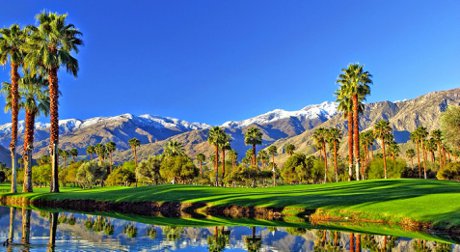
Almost every buyer I work with who starts as a snowbird eventually asks me the same question, usually somewhere around their second or third winter here: "Could we actually live in Palm Desert year round?"
It's a fair question, and the answer is more interesting than the brochures let on. Palm Desert in February is easy to love. Palm Desert in August is a different conversation, and anyone buying a $2 million to $10 million home here as a primary residence should go in with clear eyes.
In this guide you'll learn what each season really feels like, what full-time living costs that part-time owners never see, how locals handle the summer, and who tends to thrive here twelve months a year. I've sold luxury homes across the Coachella Valley for 23 years, and a good share of my clients have made the switch from seasonal to full-time. Here's what they tell me, and what I tell them before they do.
What Each Season Actually Feels Like in Palm Desert
The simplest way to understand year-round life here is to stop thinking of it as one climate. It's really four very different chapters.
October through December: the reset. The heat breaks, usually by mid to late October. Clubs reopen their courses after fall overseeding, restaurants bring back full menus, and the snowbirds begin to arrive. Ask most full-timers and they'll tell you this is their favorite stretch of the year. Days are in the 70s and 80s, the town is waking up, and you still get a tee time.
January through April: high season. This is the Palm Desert most people picture. Sunny days in the 60s and 70s, El Paseo busy on a Saturday night, the BNP Paribas Open in Indian Wells in March, and festival season in April. The tradeoff is people. Highway 111 slows down, dinner reservations need planning, and the seasonal population swells noticeably. The City of Palm Desert has reported roughly 53,000 permanent residents plus around 32,000 seasonal residents, so you can feel the town nearly double in personality during these months.
May through September: the real summer. Let's be direct. July and August highs regularly run well above 100°F, and it's common to see stretches above 110°F. Late summer can bring monsoon moisture, which adds humidity that surprises people who were promised "dry heat." Evenings stay warm, often in the 80s or even 90s after dark in midsummer.
What surprises people about summer: it's also the quietest, easiest time to live here. No traffic, no waits, and the town belongs to the locals. Many full-timers say summer is when Palm Desert feels most like a small town.
Year-Round vs. Seasonal Ownership: The Costs and Tradeoffs Nobody Mentions
If you've owned here as a second home, you've mostly seen the "good half" of the cost picture. Living here full-time changes a few line items in ways that matter at the luxury level.
Electricity is the big one. Palm Desert homes are served by Southern California Edison, with some parts of the east valley served by the Imperial Irrigation District. Rates are high relative to the national average, and cooling a large home through July and August takes real power. For a big estate without solar, it is not unusual to see summer bills reach four figures a month. This is one reason solar, dual-pane glass, spray-foam insulation, and modern variable-speed HVAC systems carry so much value with full-time buyers. When I walk a home with a client planning to live here year round, I ask about the age of the AC units before I ask about the countertops.
Pools behave differently. Seasonal owners heat their pools in winter. Full-timers sometimes find their pool water too warm to be refreshing in August. Some luxury owners install pool chillers or simply shift swim time to early morning.
Landscaping and exterior wear. Sun is hard on paint, wood, roofing underlayment, and outdoor furniture. Full-time owners budget for more frequent exterior maintenance than people expect coming from the coast.
What you save. Seasonal owners pay for home watch services, summer pest checks, and the general risk of an empty house in extreme heat (an AC failure in an unoccupied home in August can mean real damage). Full-timers skip much of that. Many also find that the Palm Desert property tax and cost-of-living picture compares well against Orange County, Los Angeles, or the Bay Area for a comparable home and lot.
Club life changes too. Many private clubs in Palm Desert, Indian Wells, and Rancho Mirage run reduced summer schedules, close courses for overseeding in the fall, and shift dining hours. Full-time members often love the quiet summer club scene, but it's smart to ask any club you're considering what's open from June through September.
A quick note on market context: Palm Desert's citywide median sale price sat in the mid $500Ks through mid-2026, but that number tells you very little about the $2 million and up segment, where pricing depends almost entirely on the community, the lot, the views, and club membership. For luxury pricing, look at the specific enclave, not the citywide figure.
Why Palm Desert Works for Full-Time Luxury Living
Plenty of desert cities are beautiful in winter. What makes Palm Desert work as a twelve-month home is everything that keeps running when the visitors leave.
Healthcare is close. Eisenhower Health in neighboring Rancho Mirage is a major regional medical campus, and for many retirees and relocating executives that access is a deciding factor.
Real infrastructure. Palm Desert has its own university presence (Cal State San Bernardino's Palm Desert Campus and UC Riverside's Palm Desert center), the McCallum Theatre, The Living Desert Zoo and Gardens, and El Paseo, which remains one of the best shopping and dining streets in the desert. These are things a town builds for people who live here, not just people visiting.
Locals get perks. Desert Willow Golf Resort, the city-owned course, offered Palm Desert resident cardholders a $40 summer green fee in 2026, with a resident able to bring one non-resident guest at the same rate. Small benefits like that add up for full-timers.
The summer escape is short. This is the secret most locals know. Highway 74 (the Pines to Palms Highway) climbs from Palm Desert into the San Jacinto Mountains, and Idyllwild's cooler pine air is roughly an hour away. The beaches of San Diego and Orange County are typically a two to three hour drive. Plenty of full-time residents simply plan a few weeks away in July or August and spend the other ten or eleven months enjoying the best weather in California.
How locals actually live through summer. Golf at first light, sometimes on the course before 6 a.m. Errands done by 10. Afternoons inside, at the club, or by a shaded pool. Dinner later in the evening when it cools. Once you adjust your rhythm, summer becomes a season of quiet routines rather than something to endure.
Who thrives here full-time. In my experience, the buyers who love year-round life in Palm Desert tend to be people who enjoy a slower summer, value space and privacy, travel a few weeks a year anyway, and want a strong club or community social life. The buyers who struggle are usually the ones who expected February weather in August and never built a summer plan.
Work With a Local Expert: Call 760-880-8385
Choosing a home you'll live in twelve months a year is a different decision than choosing a winter getaway. Orientation of the house matters (west-facing glass in August is no joke). HVAC and solar matter. The right community matters, because some feel lively year round and others go nearly silent in summer.
I've helped buyers across Palm Desert, Indian Wells, Rancho Mirage, La Quinta, and Palm Springs for 23 years, and I hold the CLHMS luxury designation. When clients are considering a full-time move, I'll tell you which communities have a strong year-round population, which homes are built to handle the heat efficiently, and what your real monthly costs are likely to be, including the summer ones.
Call or text me directly at 760-880-8385. You'll work with me personally from first showing to closing.
The Bottom Line on Living in Palm Desert Year Round
Living in Palm Desert year round is very doable, and for the right buyer it's one of the best lifestyle decisions in California. Eight or nine months of the year are spectacular. The summer is real, but with the right home, a smart routine, and a short getaway or two, it becomes the quiet season locals quietly enjoy.
If you're thinking about making the move from seasonal to full-time, or relocating here for the first time, let's talk. Book a call or download the free Palm Desert buyer guide at desertrealestatesearch.com, or call me at 760-880-8385.
Follow and subscribe to our Palm Desert Living YouTube channel: www.youtube.com/@RyanGaertnerRE. New videos on desert neighborhoods, market updates, and luxury homes every week.
About the Author
Ryan Gaertner is a luxury real estate broker in the Coachella Valley with 23 years of experience and more than $400 million in closed sales. He works with EQTY Real Estate at Coldwell Banker Global Luxury, holds the CLHMS designation, and is a Diamond Preferred partner with Concierge Auctions. Ryan represents buyers and sellers personally, with no handoffs, across Palm Desert, Indian Wells, Rancho Mirage, La Quinta, and Palm Springs. CalDRE 01372839. Call or text 760-880-8385 or visit desertrealestatesearch.com.